Article From & Read More ( Samsung Galaxy A52 5G: Is "good" good enough? - Engadget )
https://ift.tt/3eO2SfK
Technology
Friday, April 30, 2021
New iPad Pro, Apple TV 4K, and 24-inch iMac now available for order - Ars Technica
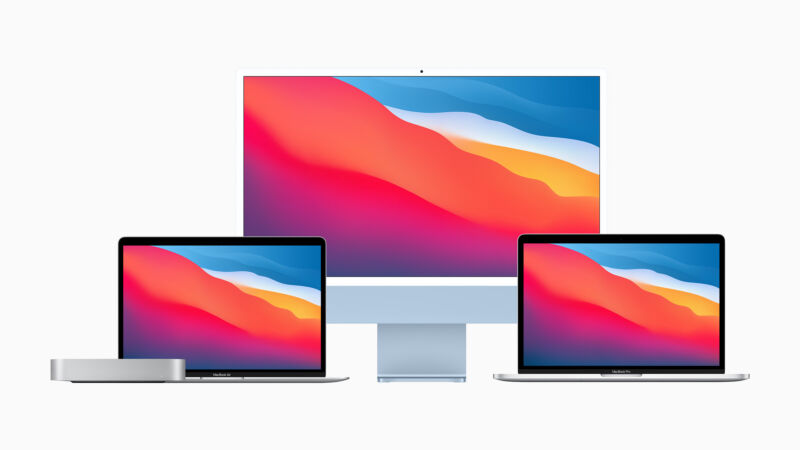
Enlarge / An Apple-made image of the various Macs running on the M1 to date.
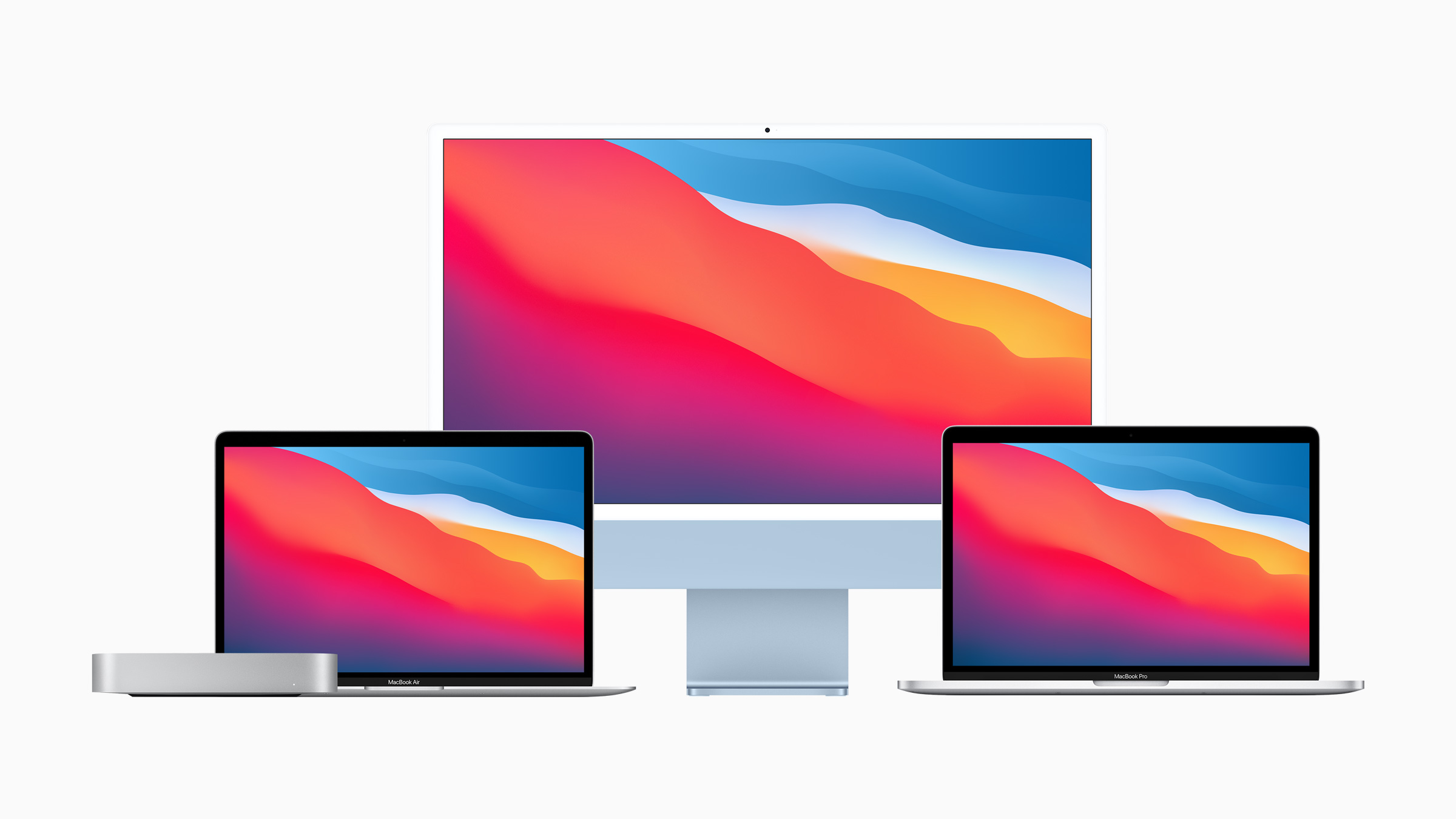
As previously announced, today is the day: orders are open on the Apple Store and through other retailers for the remaining hardware products that Apple announced on April 20: the 24-inch iMac and the new iPad Pro and Apple TV 4K.
Yesterday, we reported that multiple leaks seemed to reveal a May 21 ship date for these products, and those leaks turned out to be correct. The initial ship date for all of the above was May 21, but ship estimates have slipped slightly due to demand for some products—and significantly for others.Specifically, most configurations of the 24-inch iMac, 11-inch iPad Pro, and Apple TV 4K are currently showing ship dates between May 21 and 27, while some specific configurations of the iMac and 11-inch iPad Pro are shipping in early June. The worst case, though, is the 12.9-inch iPad Pro, which in some configurations is shipping as late as July.
The 12.9-inch iPad Pro has a Mini LED display similar to the one seen in Apple's Pro Display XDR monitor, as well as recent high-end consumer LCD TVs. The 11-inch model still has the previous generation's display technology and is shipping sooner, suggesting that the new display tech is a bottleneck.
The other major improvement in both new iPad Pro models is the inclusion of the M1 system-on-a-chip seen in recent Macs. That chip also powers the new 24-inch iMac, which comes in multiple colors and has been redesigned visually since the last 21.5-inch model it (mostly) replaces.
The Apple TV 4K has seen the least dramatic changes of the new devices. For most use cases, it's identical to its predecessor. Compared to the version that was on sale before today, it has a faster processor; it went from Apple's A10 to the A12. And it has an HDMI 2.1 port, which may allow it to support 120 Hz playback and other modern TV features in the future.
The biggest change is arguably a redesigned remote, but that remote is also available on its own (it's compatible with the previous generation) as well as in a bundle with the lower-end Apple TV HD.
Article From & Read More ( New iPad Pro, Apple TV 4K, and 24-inch iMac now available for order - Ars Technica )https://ift.tt/3gWvdmP
Technology
Galaxy S21 FE: Everything we know so far about the 2021 flagship killer - SamMobile
Samsung hit it out of the park with the launch of the Galaxy S20 FE last year. The Fan Edition device proved to be one of Samsung’s most successful of the year, so it’s only natural for the company to want to release a sequel this year and try to catch lightning in a bottle again.
Predictably, the sequel should be called the Galaxy S21 FE, and much like the predecessor did last year, the upcoming model should draw some inspiration from the premium Galaxy S lineup while maintaining a good value and a sub-flagship price.
There’s almost no doubt that Samsung will be releasing the Galaxy S21 FE this year. The company has at least indirectly-acknowledged that the phone exists when it accidentally mentioned it on the official Samsung Mexico portal this week.
Either way, Samsung will have a steep hill to climb if it wants the Galaxy S21 FE to become a worthy successor to the 2020 model, and the company does appear to have what it takes to achieve this, judging by all the leaks so far. Here’s an overview of everything we know:
Galaxy S21 FE design and color options
Much like the Galaxy S20 FE’s design was inspired by the premium Galaxy S20 trio of flagships, the upcoming Galaxy S21 FE is expected to adopt a new design language akin to the Galaxy S21.
Leaked press renders depicting the Galaxy S21 FE indicate that the phone will follow the same design principles as the Galaxy S21 series, particularly in regards to the camera housing. It wraps around the top and side edges of the device, and as a result, it look less like an afterthought.
SamMobile exclusively reported a couple of months ago that the Galaxy S21 FE will be released in at least four color options including gray/silver, pink, violet, and white. A fifth color — light green — was also discovered just a few weeks ago, along with a few camera details.
Galaxy S21 FE hardware and camera specifications
The Galaxy S21 FE is expected to carry a triple-camera combo on the back panel, though detailed specifications are unknown. As far as the selfie camera goes, it’s been reported that it should clock in at a resolution of 32MP, though only time will tell if it’s the same 32MP sensor that was used for the Galaxy S20 FE or an upgraded shooter.
There aren’t too many details on the hardware but battery details have emerged in mid-April. According to this data, the Galaxy S21 FE should be powered by a 4,500mAh battery, same as the Galaxy S20 FE.
Battery life could end up being better thanks to the adoption of components that have a higher energy-efficiency. The Galaxy S21 FE’s choice of chipsets hasn’t been confirmed yet but the phone could be offered with an Exynos 2100 and / or Snapdragon 888 SoC, and with two storage options: 128GB and 256GB.
The device is expected to have a 6.4 / 6.5-inch Super AMOLED Infinity-O display with a refresh rate of at least 90Hz, though 120Hz is a fairly safe bet given the fact that the Galaxy S20 FE already has this feature. Stereo speakers and an IP rating should also be par for the course.
When will the Galaxy S21 FE become available?
An alleged roadmap detailing Samsung’s launch plans for 2021 got leaked last month, and it suggests that the Galaxy S21 FE will be unveiled at a dedicated Unpacked event scheduled for August 19.
Leaked roadmaps may not always be a good source of accurate release date details, but what’s important to note about this particular roadmap is that it predicted the date of the Galaxy Book Unpacked event with pinpoint accuracy. This lends a bit more credibility to the idea that August 19 is the day when Samsung will reveal the Galaxy S21 FE to the world.
Pricing details remain unknown but the company is expected to stay true to the FE lineup and release the upcoming model within the so-called “flagship-killer” price range.

- Model: SM-G990B
- Dimensions: Bar: x x mm
- Display: 6.5 inch / 165.1 mm
- CPU: Exynos 2100
- Camera: 12MP
https://ift.tt/3e3ht7X
Technology
Today I learned that card grading companies are drowning in Pokémon cards - The Verge

A report from Vice has opened my eyes to just how big the Pokémon trading card collecting market is getting — apparently to the point where card rating companies have waitlists that range from six to ten months, with one company claiming it’s receiving over 500,000 cards to grade per week. The card graders, who rate trading cards’ conditions to determine how collectable (and therefore valuable) they are, are so swamped that people who want to get their Magic, Yu-Gi-Oh, or sports cards graded are also having to wait in line (or pay out the nose to skip it).
One card rating company apparently needed employees so bad it offered $1,000 starting bonuses — and then bumped them up to $2,500. Another company had to buy two warehouses to store all the cards it was getting in. Apparently, even the the most basic original Pokémon cards can fetch upwards of $40 now in excellent condition, and graded cards can be worth up to 20 times their value in perfect condition.
Of course, we’ve also seen the boom affecting the market in other ways— eBay is adding a feature to its app specifically to scan cards and pre-populate listings with info (though not the card’s condition), making it slightly faster to list them. The Vice report also mentions that plastic card protectors have been completely selling out.
Most of these effects seem linked to older Pokémon cards, as they’re the ones that are scarce — as the author of the Vice article points out, people are looking to see if they’ve got any that escaped the ravages of being childhood playthings after seeing collectors like Logan Paul buying original cards or packs for obscenely high prices.
But it also seems like some of the OG Pokémon shine has started to affect the market for new collectibles with unproven value, too: some Target stores have threatened to call police on people camping outside for new Pokémon card restocks, and the Pokémon card company has rushed to pump out as many new cards as it can.
Maybe the pandemic has awoken people’s inner magpies, turning on an insatiable desire to collect without really considering the value of what we’re buying (just look at NFTs, which feel like peak collectible). Of course, there are also those truly rare Pokémon cards that are quite valuable — but it can’t just be the rare cards hitting these card rating companies with, as one CEO put it, “an avalanche of cardboard.”
Honestly, seeing this news, on top of everything else, has left me with one burning question: where the heck are people getting so much money that they can spend $660K on a Mario cartridge or $300K on a Pokémon card?
Article From & Read More ( Today I learned that card grading companies are drowning in Pokémon cards - The Verge )https://ift.tt/3nAIUsS
Technology
Returnal is a Showcase for the PS5's Power - Next-Gen Console Watch - IGN
Article From & Read More ( Returnal is a Showcase for the PS5's Power - Next-Gen Console Watch - IGN )
https://ift.tt/3t1LWYd
Technology
https://ift.tt/3t1LWYd
Technology
Roku: YouTube TV app removed from channel store as deal with Google ends - CNET

Roku's streaming devices are among the most popular in the US.
Sarah Tew/CNETRoku said Friday that Google's live TV streaming service, YouTube TV, has been removed from its channel store because the companies' distribution agreement has expired. Roku users who have already installed YouTube TV on their devices can continue to stream it, but no new customers can sign up for YouTube TV on Roku -- nor download the channel if it isn't already installed.
The main YouTube app on Roku is unaffected. Roku's standoff with Google concerns only the app for YouTube TV, a subscription service that streams live television channels, typically used as an alternative to cable or satellite for cord cutters.
YouTube TV's removal from Roku's store is an escalation of a standoff between two different technology powers. Google is one of the most monolithic companies in tech, with domination of markets like internet search and advertising that is so strong it is facing a host of investigations into monopoly abuse. Roku is far smaller, but it has emerged as one of the leading forces in streaming-TV distribution, an area that has only grown -- both in popularity and opportunity -- during the pandemic.
Roku is "disappointed that Google has allowed" the agreement for YouTube TV to expire, the company said in a statement. Roku reiterated points it made earlier this week when it first disclosed that the service could potentially be removed from its platform: The company said that it isn't seeking greater payments from Google but is standing firm on points such as search-result manipulation, access to data, hardware requirements that could increase devices cost and what it claims are "discriminatory and anticompetitive" actions by Google.
YouTube denied making "any requests to access user data or interfere with search results," saying the claim is "baseless and false."
"Our agreements with partners have technical requirements to ensure a high quality experience on YouTube," it said in a statement Friday. "Roku requested exceptions that would break the YouTube experience and limit our ability to update YouTube in order to fix issues or add new features. For example, by not supporting open-source video codecs, you wouldn't be able to watch YouTube in 4K HDR or 8K even if you bought a Roku device that supports that resolution."
Google is facing attacks and investigations into whether it abuses monopoly power on several fronts. Last week, Google was grilled by senators on an antitrust subcommittee about accusations it uses the marketplace heft of its Google Play app store to retaliate against rivals and entrench its own power.
Carriage disputes between programmers and distributors are nothing new: They're a routine annoyance for customers of traditional cable and satellite TV. But up until last year, these kinds of service "blackouts" were one of the ways streaming set itself apart from the aggravations of television's past.
In the last year, however, they've cropped up with the rollouts of big, new streaming services, with both HBO Max and NBCUniversal's Peacock failing to launch with Roku support. The standoff between Roku and Google demonstrates that even with long-established apps, companies on both sides may agitate to get the upper hand as the dynamic of power evolves toward TV's future.

Watch this: Roku Voice Remote Pro review: 'Hey Roku' only goes so...
5:13
The tensions come as streaming has grown more popular than ever, amplifying a long trend of people watching more video via the internet. Streaming distributors like Roku and streaming programmers like YouTube both want to control the data, money, programming and discovery tools at the heart of your streaming. Both sides also want to entrench themselves in positions of power for the next era of television.
Google has never disclosed how many people subscribe to YouTube TV. The number of people who use the service is surely dwarfed by the more than 2 billion people who watch YouTube's main video service. But most YouTube viewing occurs on mobile devices, and YouTube TV -- though much smaller -- is the kind of service that tends to be watched most on televisions, often via a streaming device like Roku.
CNET's Sean Keane contributed to this report.
Article From & Read More ( Roku: YouTube TV app removed from channel store as deal with Google ends - CNET )https://ift.tt/330ayWW
Technology
Roku vs. Google, part 2: YouTube TV app pulled from Roku Store - Ars Technica
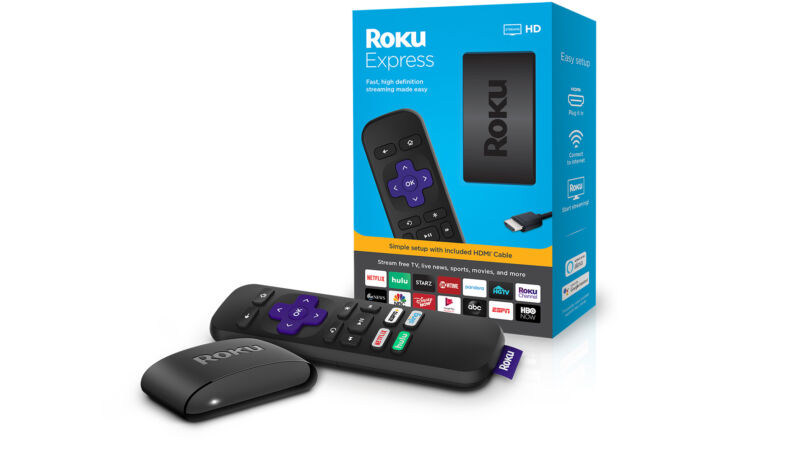
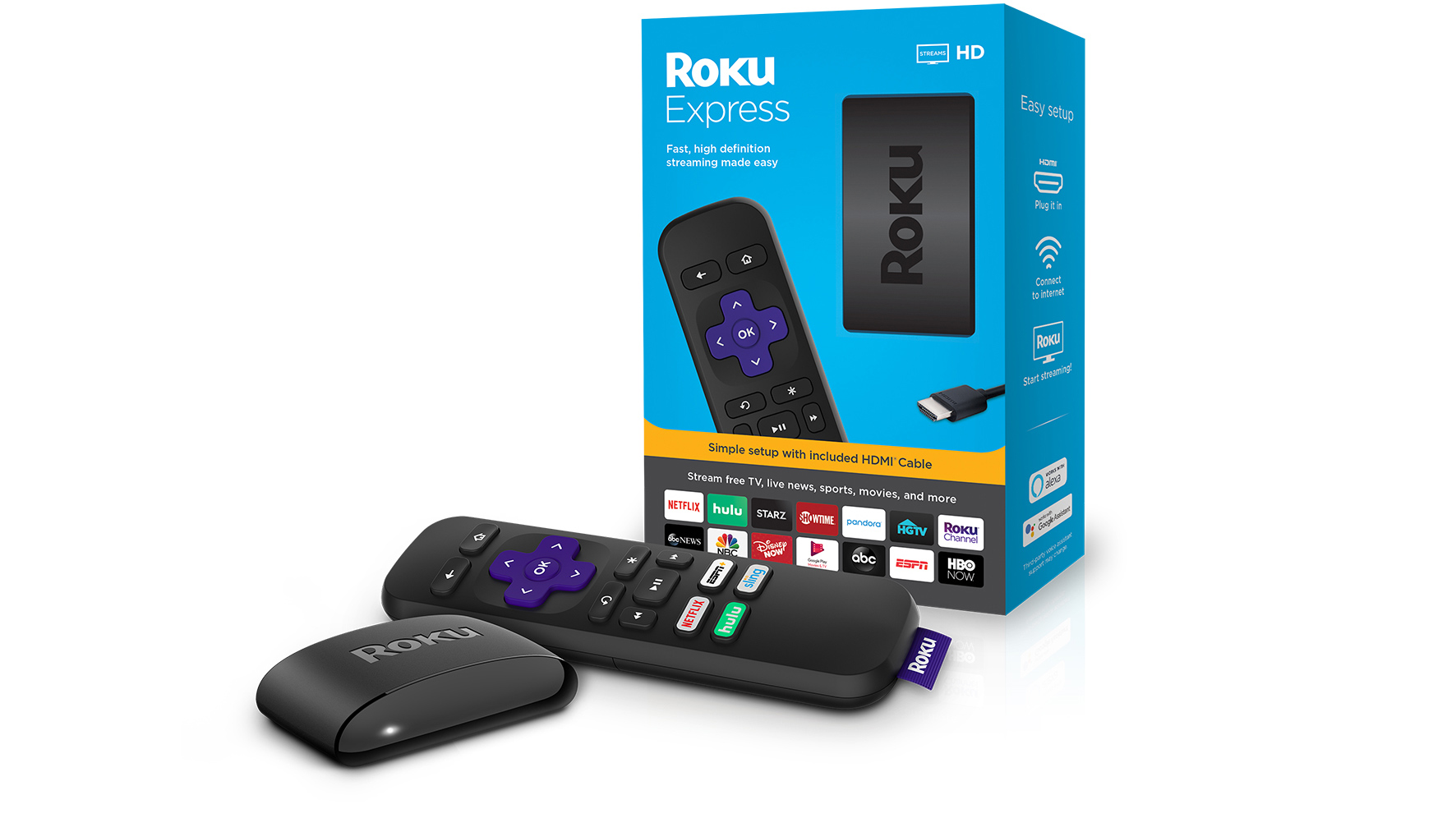
Roku warned us on Monday that this could happen. This morning, the company announced that YouTube TV is no longer available on the Roku Channel Store. Google and Roku are squabbling over Roku's carrying agreement, just like you might see in an old-school cable TV carriage dispute. The main point of contention seems to be over the AV1 video codec, a new, more efficient video standard that seems poised to be the new standard going forward.
With the two companies unable to come to an agreement, Roku says the YouTube TV app—an app for a $65-per-month service that delivers 85+ live cable TV channels over the Internet, not the normal YouTube app—has been pulled from the Roku channel store. Existing users will continue to be able to use the YouTube TV app on their Roku devices, but new users won't be able to sign up. Here is Roku's full statement:
We are disappointed that Google has allowed our agreement for the distribution of YouTube TV to expire. Roku has not asked for one dollar of additional financial consideration from Google to renew YouTube TV.
We have only asked Google for four simple commitments. First, not to manipulate consumer search results. Second, not to require access to data not available to anyone else. Third, not to leverage their YouTube monopoly to force Roku to accept hardware requirements that would increase consumer costs. Fourth, not to act in a discriminatory and anticompetitive manner against Roku.
Because our contract has expired, we have removed YouTube TV from our channel store. To continue to provide our users with a great streaming experience, we are taking the extra step to continue to offer existing subscribers access to YouTube TV on the Roku platform unless Google takes actions that require the full removal of the channel. Because of Google's conduct, new subscriptions will not be available going forward until an agreement is reached.
It is well past time for Google to embrace the principles that have made streaming so popular for millions of users by giving consumers control of their streaming experience, by embracing fair competition and by ceasing anticompetitive practices. We believe consumers stand to benefit from Google and Roku reaching a fair agreement that preserves these principles and we remain committed to trying to achieve that goal.
Today, Google published a blog post in response, saying, "Despite our best efforts to come to an agreement in the best interests of our mutual users, Roku terminated our deal in bad faith amidst our negotiation. Unfortunately, Roku has often engaged in this tactic with other streaming providers." Google flatly denied Roku's claims that Google wanted user data and wanted to manipulate search, saying, "To be clear, we have never, as they have alleged, made any requests to access user data or interfere with search results. This claim is baseless and false."
The 411 on AV1
While these negotiations were supposed to be about the $65-per-month cable TV replacement service YouTube TV, Google says Roku "chose to use this as an opportunity to renegotiate a separate deal encompassing the YouTube main app, which does not expire until December."
The statements from Google and Roku seem to dance around the issue of AV1 video codec support, which an earlier report from Protocol revealed is at the core of this dispute. Roku says that Google was trying to "leverage their YouTube monopoly to force Roku to accept hardware requirements that would increase consumer costs," while Google says that "[o]ur agreements with partners have technical requirements to ensure a high quality experience on YouTube."
Google continues, saying, "Roku requested exceptions that would break the YouTube experience and limit our ability to update YouTube in order to fix issues or add new features. For example, by not supporting open source video codecs, you wouldn’t be able to watch YouTube in 4K HDR or 8K even if you bought a Roku device that supports that resolution." It's not clear why no one can write the letters "AV1" in a blog post, but this statement is definitely about the upcoming video codec.
AV1 is the successor to Google's VP8 and VP9 video codecs, and development has moved from being an in-house Google project to an industry-backed "Alliance for Open Media." AV1's bandwidth-saving potential and royalty-free license have earned it backing from nearly every big video and hardware company, including Google, Apple, Amazon, Netflix, Microsoft, Samsung, Intel, Facebook, Arm, Hulu, and a ton of other companies. Like all advanced video codecs, AV1 requires hardware decode support for playback on slower devices like streaming sticks, set-top boxes, and phones, hence all the allusions to "hardware" and "technical" requirements. Google has been pushing manufacturers to pack in these brand-new, more expensive SoCs so that it can roll out AV1 support to a wide audience.
Google is very enthusiastic about AV1. Bandwidth is a major cost of running YouTube, and anything that results in Google sending less data to play a video can save the company tons of cash. Google is so aggressive about switching to AV1 that it created its own video transcoding chip to make the work of re-encoding YouTube's massive video collection over to AV1 easier.Despite Google's internal zeal for AV1, when it comes to streaming hardware, Roku is actually doing a better job supporting AV1 than Google. The official scoreboard shows that Roku has one AV1-compatible device, the $100 Roku Ultra, while Google sells zero AV1 streaming devices. Google's newest, most expensive dongle, the $50 Chromecast with Google TV, does not have a chip that supports AV1. Google has made AV1 support mandatory for Android TV devices, but again, those are other companies' devices. Google should be leading by example here, but it isn't.
No one has been able to get AV1 working on an inexpensive streaming box, and Roku's $100 Ultra is about the cheapest AV1 streaming box on the market. Roku goes way more down-market than that, though, and it does not seem like the company could offer the Roku Express at the current $29.99 MSRP if it had AV1 support.
While the two companies aren't seeing eye to eye on the AV1 codec, Google says this doesn't have to result in the immediate takedown of YouTube TV. The company says, "Our offer to Roku was simple and still stands: renew the YouTube TV deal under the existing reasonable terms."
Article From & Read More ( Roku vs. Google, part 2: YouTube TV app pulled from Roku Store - Ars Technica )https://ift.tt/3u7Uv5p
Technology
Returnal's First Boss Gameplay - Surviving Bullet Hell - IGN
Article From & Read More ( Returnal's First Boss Gameplay - Surviving Bullet Hell - IGN )
https://ift.tt/3xBs6GJ
Technology
https://ift.tt/3xBs6GJ
Technology
Samsung is being sued over defective camera glass on the Galaxy S20 series - XDA Developers
A class-action lawsuit has been filed against Samsung for providing ‘defective’ glass on the camera of its flagship series, the Galaxy S20. According to the law firm Hagens Berman, Samsung has ignored a widespread defect prevalent on the Galaxy S20 series of smartphones where the protective glass on top of the camera module shatters unexpectedly during normal use
Samsung is being accused of fraud, breach of warranty, and violations of several consumer-protection laws. The press note shared by the law firm on its website says that Samsung sold its smartphone range with a defect affecting the rear camera module’s glass that apparently shatters spontaneously, with no external force applied, even when the phone is inside a protective case. The defect is said to be affecting the entire Galaxy S20 series including the Galaxy S20, Galaxy S20+, Galaxy S20 Ultra, Galaxy S20 FE, and all the 5G variants of these phones as well. Notably, this issue has been around ever since the phone series first launched as a certain owner of the Galaxy S20 reported about the issue on Samsung’s community website just four days after it went on sale.
“Samsung sold its Galaxy S20 as a high-end option for consumers, with a ‘professional’ grade camera, charging upwards of $1,600 per device, only to have them suddenly lose a major aspect of their functionality. During a time of social-distancing and increased use of online access, consumers are especially in need of a reliable mobile device, yet Samsung has refused to deliver the reliability it promised its customers,” said Steve Berman, managing partner of Hagens Berman and attorney for consumers in the class action.

According to consumers, Samsung has refused to cover the issue under warranty and is asking $400 to send the phone back to Samsung to investigate the issue or $100 under purchased Samsung care device insurance to repair the shattered glass. Even after complying with the costs, certain consumers are repeatedly facing the issue, while others have paid hundreds of dollars at third-party repair shops.
The press note cites a post on the Samsung consumer forum by a Samsung Care Ambassador as saying, “This happened to one of our ambassadors. After many complaints about the issue, we found out that it has to do with pressure buildup underneath the glass and not customers banging it against something.” Despite Samsung acknowledging the issue, the company did not resort to a recall and apparently continues to deny customer warranty claims.
The lawsuit sounds like good news for customers affected by the issue. The law firm also offers a form on its website that you can fill out and seek compensation. However, even if the lawsuit goes in the favor of consumers, there is no guarantee that you would receive enough money that can cover the cost of your repairs.
Article From & Read More ( Samsung is being sued over defective camera glass on the Galaxy S20 series - XDA Developers )https://ift.tt/3t7D1V7
Technology
Alibaba is concerned about how Apple’s new privacy policies will affect its business - 9to5Mac
With the release of iOS 14.5 and the App Tracking Transparency feature, multiple companies that have ad-based businesses have been getting concerned as Apple’s privacy policies now let users opt-out of being tracked by third-party apps. Last week, Alibaba Group invited some marketing executives to discuss what to do about the changes introduced with iOS 14.5.
The Chinese group owns one of the largest e-commerce companies in the world, and also has an extremely popular online ad platform in China. The privacy changes introduced in iOS 14.5, of course, have not made the company happy.
According to The Information, half a dozen marketing industry executives went to Alibaba’s headquarters in Hangzhou to discuss how the company can protect its revenue following the introduction of App Tracking Transparency on iOS. However, the report heard that the company has not reached a consensus on how to deal with Apple’s new privacy policy.
China is one of Apple’s largest markets, with more than 300 million active iPhone in the country. The restrictions imposed by Apple on how developers must handle user data will have a direct impact on companies like Alibaba, whose 40% of revenue comes from advertising.
Earlier this year, it was reported that some Chinese companies were working on new ways to bypass the iOS privacy system in order to keep tracking users even when they choose not to be tracked. Apple later said that App Tracking Transparency is mandatory in any region and that apps that do not follow the rules will be removed from the App Store.
Alibaba is not alone when it comes to companies that are worried about their revenue coming from advertisements. A leaked Facebook memo on Wednesday revealed that the company expects advertiser revenue (and therefore its own) to be affected as iPhone and iPad users update to iOS 14.5.
Read also:
FTC: We use income earning auto affiliate links. More.
Check out 9to5Mac on YouTube for more Apple news:
Article From & Read More ( Alibaba is concerned about how Apple’s new privacy policies will affect its business - 9to5Mac )https://ift.tt/331mTtV
Technology
Atari VCS hands-on: A computer-console hybrid with an identity crisis - CNET

Like the storied brand it takes its name from, the new Atari VCS has a complicated history. Originally a crowd-funded project, now years overdue, it's finally starting to ship to crowdfunding backers and, soon, to the general public. Just as the original Atari company got caught up trying to figure out if it was a game console manufacturer, a software publisher, a computer maker or just a cultural icon, the Atari VCS feels similarly conflicted. It might be a game console. It might be a DIY-friendly, small-form-factor desktop PC. It doesn't fully satisfy as either, even at a modest $399 (which includes a wireless gamepad and a wireless retro joystick).
I first tried one of these systems out two years ago, when I was intrigued by the idea of a console that could also be a Windows or Linux PC. The idea of leaning so heavily on classic Atari games was probably the least interesting part of it for me, especially as these games are available in so many other places. If I want to play Asteroids, Crystal Castles or Centipede, even in various home console and arcade iterations, that's easy enough to do on almost any other platform.
That said, there's a real vintage, authentic vibe here, to both the hardware and software. This looks and feels like an Atari product, down to the clever re-implementation of the classic Atari 2600 joystick. But keep in mind that the Atari brand is just corporate IP now. It's been bought and sold over the years, and is now owned by a French game company formerly known as Infogrames.
A confusing identity
In my hands-on time with it, it's obvious that the Atari VCS suffers from an identity crisis. One pitch for it is as a game console. There's a lot of competition in that space, from the PS5 and Xbox Series X to the Nintendo Switch and the Xbox Series S. The Series S is $299 while the Switch Lite is $199, and both are far more capable pure gaming machines than this. If retro games are your thing, systems like the SNES Classic and Sega Genesis Mini are both under $100 and do a great job of making classic games easy to play on modern TVs.
Read more: PS5 and Xbox Series X are still sold out: Here's what to buy instead

The Atari VCS set up as a Windows 10 computer.
Dan Ackerman/CNETThe Atari VCS is much better thought of as a small form factor desktop, with a heavy DIY element. It runs an AMD SoC (system on chip) called the Ryzen R1606G, with just enough graphics muscle for light gaming and some expansion options like an internal M.2 slot. More importantly, you can skip the built-in Atari OS (basically a Linux-based catalog of games and a web browser) and run full Linux, Chrome OS or Windows 10 on it. Technically it supports the semi-abandoned SteamOS, too, but I wouldn't recommend that.
But there's a catch. The system only comes with its own Atari OS and a small 32GB SSD. To turn it into a real mini desktop, you need to install your preferred OS on either an external drive (connected via USB) or by adding an internal M.2 hard drive. It's a lot to ask of most people, and the entire project would make more sense shipping as a Windows or dual-boot machine.
I went through the process, installing Windows 10 on an external drive, and after a little troubleshooting, it worked fine. You could compare it to something like a Mac Mini, although the new M1-powered Mac Mini is much more powerful -- and more expensive.
Once I had Windows 10 running, naturally I installed some Steam games. Since it was built around classic Atari games, it's a stretch to ask it to do much modern gaming, I suppose. Recent indie darling Hades wouldn't run, neither would 3D Mark benchmarks. But my go-to low-power PC favorite, Deep Sky Derelicts, ran fine, as did Skyrim, at 1080p and medium settings. I also tried the new Microsoft Xbox Cloud Gaming beta, which worked well, as it's streaming from the cloud.
I could see myself using the Atari VCS hooked up to a monitor, keyboard and mouse as a fun mini desktop (and in fact, that's what I did for a few days). But you can also find more powerful hardware in a similar compact package. You're really paying for the console-like design, which is a fun conversation-starter at least. If you're using this as a desktop, however, keep in mind the internal fans will be cranking almost all the time and they can get pretty loud.
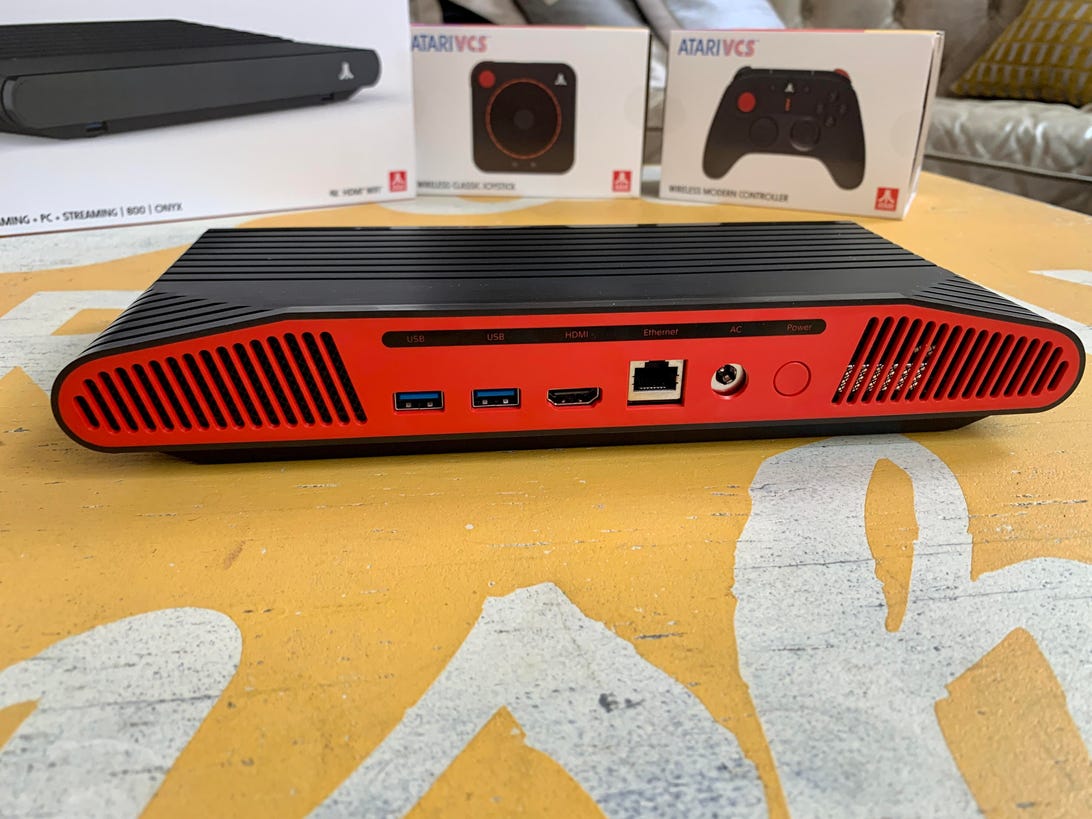
Two USB-A 3.0 ports, HDMI and Ethernet (don't worry, it has wifi).
Dan Ackerman/CNETRecreating the past
Taken as a standalone game console, the Atari VCS is a tough sell. It looks and feels a lot like the classic console (there's even a wood grain version), but once you turn it on, the available options are limited.
There are a lot of preinstalled Atari games, in both console and arcade versions. The recreations feel authentic, but really most of these will wear out their novelty value quickly. I like the ability to play, for example, the Atari 2600 version or arcade version of Asteroids. But many of the games, especially the more obscure ones, need instructions, which you have to click through and read on-screen. If you're anywhere close to my age, you'll recall those old console games all came with instruction booklets.
The menu and navigation feels fine at 1,920x1,080 resolution, but upping the output to 4K, while supported by the OS, results in a slow, stuttery experience. Not that Centipede needs to be in 4K.
A small, for now at least, storefront offers more classic games, plus a few newer ones, but nothing that you can't find on other platforms, and the newer or remastered games aren't anything you're likely to go out of your way to track down. The ecosystem feels underpopulated at the moment, which is another reason why the system makes more sense as a desktop PC.
The wireless gamepad is a perfectly good take on the Xbox controller style. Much more interesting is the semifaithful recreation of the classic one-button Atari joystick. It's frankly not that useful outside of the classic Atari console games, but it's also a great tribute to an iconic design.
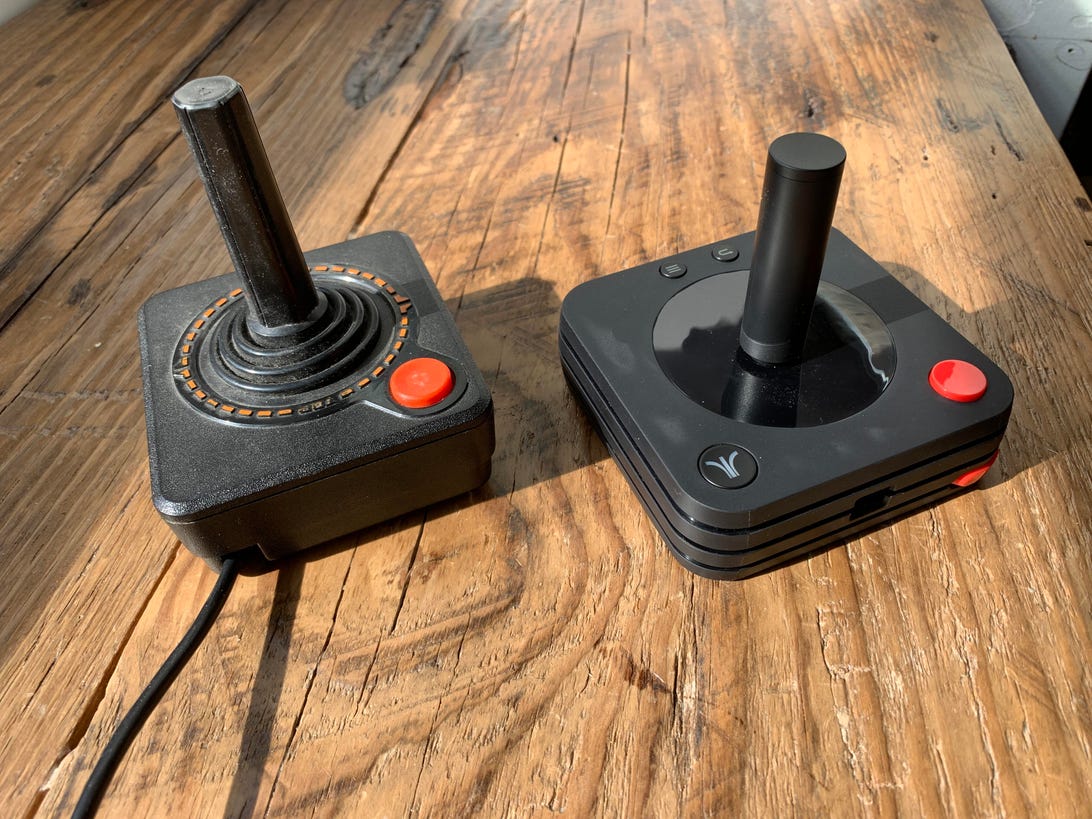
A vintage Atari 2600 joystick next to the new VCS version.
Dan Ackerman/CNETThe new version has some extra features not found on the original, including a second shoulder button, and it's wireless. It also replicates the old Atari paddle controllers -- just rotate the center stick between your fingers and it acts like a paddle. On the other hand, it lacks that classic Atari controller stiffness, so doesn't have the same muscle-memory feel as the original. Both the gamepad and joystick are available as separate $60 purchases, or come included in the current $399 bundle.
If you are a huge Atari or retro gaming fan, there's a decent chance you already backed the crowdfunding campaign or else preordered a VCS system. For everyone else, it's an interesting device that doesn't quite nail it as a standalone console nor as a desktop PC. It's best to me right now as a fun Mac Mini alternative, although you'll be paying a premium to make your 2021 computer look like it came from 1977.
Article From & Read More ( Atari VCS hands-on: A computer-console hybrid with an identity crisis - CNET )https://ift.tt/2R9OiHm
Technology
The colorful M1 iMac, Mini LED iPad Pro, and refreshed Apple TV 4K are available to preorder now - The Verge
Apple’s colorful new M1-powered iMacs, refreshed iPad Pros, and updated Apple TV 4K (with a not-terrible-looking remote) are now all available to preorder today from Apple’s website.
The company says that the new products will be delivered starting on May 21st —at least for the first wave of orders, although that timing will certainly slip as stock sells out.
Customers interested in buying the new iMac should take note that only some of the color schemes will be available in stores: green, pink, blue, and silver models will be sold in-person at Apple Store locations, but the full seven-color spectrum will only be offered through Apple’s website, at least for now.
The new iPad Pro also features Apple’s new M1 processor (the same as the iMac and last falls updated MacBooks), in addition to an upgraded ultra-wide angle camera for better video calls. Additionally, the larger 12.9-inch model will feature a new Mini LED display, which promises a far brighter and more accurate screen experience — at the cost of a $100 price increase over the 2020 model.
:format(webp):no_upscale()/cdn.vox-cdn.com/uploads/chorus_asset/file/22479128/Screen_Shot_2021_04_29_at_4.31.13_PM.png)
Also of particular note: in addition to the preorders for the updated Apple TV 4K, preorders have also opened for the standalone $59 Siri Remote for existing Apple TV HD and Apple TV 4K (first-gen) owners looking to replace the infamous first-generation Siri Remote with a (hopefully) better new design.
Alongside the preorders for the new Apple products, the first wave of last week’s AirTag and purple iPhone 12 and 12 mini devices should be arriving to both customers and in Apple Stores starting today.
Article From & Read More ( The colorful M1 iMac, Mini LED iPad Pro, and refreshed Apple TV 4K are available to preorder now - The Verge )https://ift.tt/3xAV8WZ
Technology
Let's Play New Pokémon Snap Gameplay - THE FIRST 4 HOURS - Eurogamer
Article From & Read More ( Let's Play New Pokémon Snap Gameplay - THE FIRST 4 HOURS - Eurogamer )
https://ift.tt/3aMNm2H
Technology
https://ift.tt/3aMNm2H
Technology
Apple adds a way to speed up searches on the App Store by suggesting words - The Verge
Apple has added a new App Store search suggestions feature in the US, Canada, Australia, and the UK, that might make it easier to find apps. Now, after typing in a search term, the App Store will attempt to predict what you’re looking for and offer suggested words that, when tapped, will further narrow down your search results and speed up your hunt for specific kinds of apps.
Search suggestions actually appeared on some iPhones earlier in April as part of a test, according to MacRumors, but now the feature should be rolling out to all iPhones in the supported regions.
Introducing search suggestions on the App Store!
Select (or deselect) multiple suggestions to refine your search so you can find even more amazing apps and games.
Search suggestions roll out today starting with the USA, Canada, the UK, and Australia. pic.twitter.com/viaZHlCZMb
— App Store (@AppStore) April 29, 2021
Using search suggestions is pretty simple. Let’s say I’m looking for an app to help me make some pizza from scratch: I can type “pizza” in the App Store’s search field and see additional words pop up like “maker,” “game,” “call,” “calculator,” or “order.” Selecting one of those suggestions filters the results further, so choosing calculator will pull up apps for calculating the correct ratio ingredients for pizza dough (surprisingly there’s a lot of those).
:format(webp):no_upscale()/cdn.vox-cdn.com/uploads/chorus_asset/file/22479656/Image_20.jpg)
Currently, not every search allows you to select multiple suggestions. I was able to refine Apple’s example of “food” with “delivery” and “Indian,” but my other sample searches only gave me one filter each. Not every search brings up a suggested filter, either. We’ve reached out to Apple for clarification on when suggestions appear.
What does consistently show up in search are ads, which Apple originally added to App Store search in 2016. It’s easy to see how my plan to make pizza from scratch could get derailed by a big Uber Eats or Papa John’s ad above my helpful dough calculator app. Ordering delivery is so much easier than doing math.
Those ads are likely to inflame Apple’s App Store critics further — they’ll no doubt argue that an indie developer trying to make it easier to figure out the ratios of water to flour in pizza shouldn’t have to compete with Uber’s ad budget, the same way they think competing apps shouldn’t be buying ads in front of one another’s products while Apple profits from the result. But every change to a search engine has winners and losers, and it’s not yet clear whether this one will make it easier or harder for small developers to get more exposure. They could wind up being helpful for everyone who uses the App Store.
Article From & Read More ( Apple adds a way to speed up searches on the App Store by suggesting words - The Verge )https://ift.tt/2PDB7y4
Technology
Microsoft is adding support for AAC Bluetooth audio in Windows 10 - Engadget
Windows 10’s next major update won’t include just one long overdue tweak. As reported by The Verge, Microsoft is also working on finally adding support for the AAC Bluetooth audio codec. That's great news if you own a pair of AirPods. Currently, Windows 10 limits you to SBC and Qualcomm’s AptX. AAC is most closely associated with Apple. All of the company’s Bluetooth headphones ship with the codec and default to SBC when it isn’t available.
Microsoft
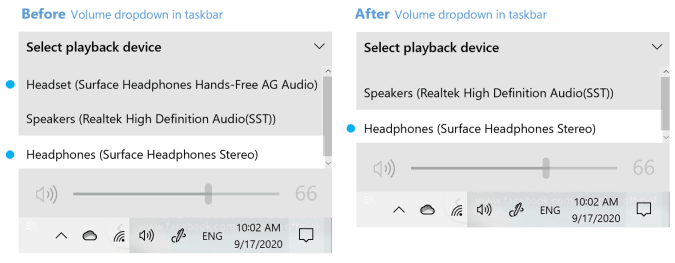
Microsoft is also changing how you select Bluetooth inputs in Windows 10. Right now, if you click on the taskbar sound menu, you’ll see multiple profiles for all the headphones and speakers connected to your computers. That’s something that can make it confusing to know what input you should click on if you want to listen to music or talk to someone. Moving forward, Windows 10 will instead automatically switch to the correct Bluetooth profile. All you have to do is select the device where you want to hear everything.
Outside of those updates, Windows 10 users can also look forward to support for Auto HDR in games and new File Explorer icons. If you’re a Windows Insider, you can test those changes by downloading and installing Preview Build 21370.
All products recommended by Engadget are selected by our editorial team, independent of our parent company. Some of our stories include affiliate links. If you buy something through one of these links, we may earn an affiliate commission.
Article From & Read More ( Microsoft is adding support for AAC Bluetooth audio in Windows 10 - Engadget )https://ift.tt/3vvrPU5
Technology
Thursday, April 29, 2021
Ratchet & Clank: Rift Apart – State of Play | PS5 - GameSpot
Article From & Read More ( Ratchet & Clank: Rift Apart – State of Play | PS5 - GameSpot )
https://ift.tt/3gPZ3tm
Technology
https://ift.tt/3gPZ3tm
Technology
Google updates latest Chromecast with more HDR controls and improved Wi-Fi performance - The Verge
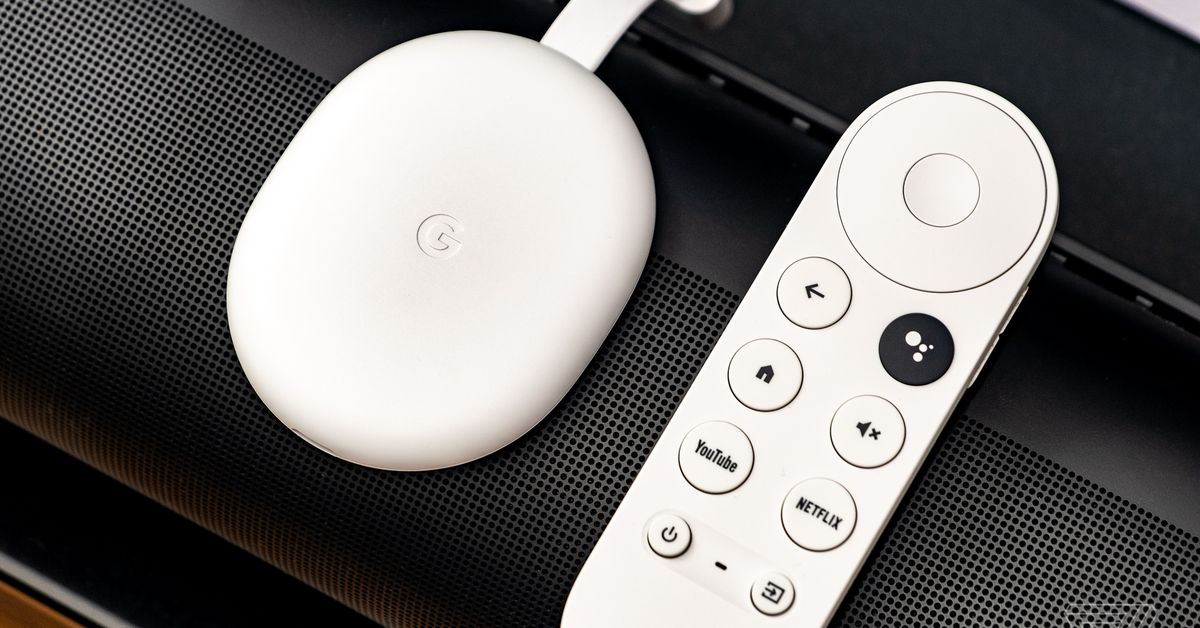
Google is rolling out a new April update for the Chromecast with Google TV that launched last year. It’s a fairly large update for a streaming device — totaling 166MB on my Chromecast — but includes numerous improvements.
Once you’ve installed the new software and restarted your Chromecast, you’ll be able to dig a little deeper into video settings than was previously possible. In the new “advanced video controls” area of settings, you’re now given the ability to choose your preferred dynamic range format. Options include Dolby Vision, HDR, or even SDR if you want to keep it there. You can also manually switch to a ton of resolutions at various refresh rates from this menu:
- 4K (60Hz / 50Hz / 30Hz/ 25Hz / 24Hz / smpte)
- 1080p (60Hz / 50Hz / 24Hz)
- 720p (60Hz / 50Hz)
- 1080i (60Hz / 50Hz)
- 576p (50Hz)
- 480p (60Hz)
Unless you’ve got a good reason to make a change, I’d keep it at whatever Chromecast selects as the default: that was 4K 60Hz in my case. Google says this update also improves the Chromecast with Google TV’s Wi-Fi performance on 5GHz networks and mesh systems. For the full list of improvements, see below. I’m still waiting for a way to clear the “continue watching” row, where shows and movies can sometimes just get stuck — even after you’ve finished streaming them.
- Advanced Video Controls setting for granular HDR formats, resolution/refresh rate, and color formats
- HDMI hotplug improvements helping your Chromecast detect the best TV Settings available
- Wi-Fi Improvements for 5Ghz and Mesh networks
- Bluetooth Audio stuttering improvements in some Apps
- HDMI-CEC can now be configured to turn on/off only the TV in settings
- Security update: Android security patch level to April 2021
Separate from this software update, the Chromecast with Google TV also recently picked up certification for HDR10+. So if you come across content on Amazon Prime Video that streams in that format of HDR, it should soon be supported on Google’s streaming gadget.
Article From & Read More ( Google updates latest Chromecast with more HDR controls and improved Wi-Fi performance - The Verge )https://ift.tt/3gQinXs
Technology
Ratchet & Clank: Rift Apart looks incredible in 16 minutes of new gameplay footage - The Verge

Sony and Insomniac Games debuted 16 minutes of stunning new Ratchet & Clank: Rift Apart gameplay footage in a new State of Play presentation on Thursday.
For part of the video, protagonist Ratchet traversed through a new town called Nefarious City that was packed with detail — it reminded me of a Ratchet & Clank version of Star Wars’ Coruscant. There was a lot of classic Ratchet & Clank gameplay on display, with 3D platforming and crates to smash for screws, but the developers have also added new moves to give you added mobility. There’s now dashing and wall running, for example, and you can also use the new Rift Tether to hook into portals so you can zip from place to place.
Another part of the video starred Rivet, a new Lombax resistance fighter that lives in a different dimension than Ratchet and Clank’s. She’s voiced by Jennifer Hale, known for her roles in Mass Effect, Halo, Overwatch, and more.
Like Returnal, Rift Apart will take advantage of the DualSense’s adaptive triggers to offer different actions for your guns based on how far you pull the trigger. Sony also showed off some new weapons, like the Shatterbomb, which launched grenade-like bombs at oncoming baddies.
The game looks great, and fortunately, we won’t have to wait long to play it — Rift Apart will be out on June 11th.
In the State of Play show, Sony also revealed that Among Us is hitting PS4 and PS5 in 2021 and showed off new footage of Subnautica: Below Zero, which launches on May 14th.
Article From & Read More ( Ratchet & Clank: Rift Apart looks incredible in 16 minutes of new gameplay footage - The Verge )https://ift.tt/3aRh0nh
Technology
Skate City - Pre-order Trailer - Nintendo Switch - Nintendo
Article From & Read More ( Skate City - Pre-order Trailer - Nintendo Switch - Nintendo )
https://ift.tt/3vtbvD7
Technology
https://ift.tt/3vtbvD7
Technology
You can install the One UI version of Google Messages on a Pixel - 9to5Google
It emerged earlier this week that Google’s default RCS client is rolling out a Samsung-specific design for the Galaxy S21 series. Those curious about how it looks and works can install the One UI variant of Google Messages on non-Samsung devices, including Pixel phones.
Version 7.9.052 (Pine_RC01.phone_samsung_dynamic) of Google Messages is responsible for enabling the One UI look. After installing the APK split/bundle — some instructions here — you might want to force close the app first to get the redesign working properly.
After that, you get a large header above the search field. The app’s name is noted, along with a rather useful count of how many unread SMS texts/RCS chats you have. That box has an off-white background that’s a very light gray. Similarly, when the dark theme is enabled, AMOLED black is used above, while the messaging list remains gray. This two-tone color also appears at the bottom of your screen if you don’t have a full list of messages.
The only other accommodation made for Samsung devices is how the “Start chat” FAB in the bottom-right corner is a circle. Besides dropping the pill and descriptive text, a light shade of blue is used.
Sideloading this version of Google Messages provides a brief glimpse into One UI for those curious, but it does not make too much sense on Pixel phones. As my colleague Ben Schoon pointed out during a recent episode of Alphabet Scoop, screens on Google phones aren’t tall enough to require blank space to push down content for your fingers.
Meanwhile, Google will presumably disable this ability to install a different OEM version of Messages in the future. Incoming texts and RCS chats are received correctly, but it’s unclear if there are any downsides to sticking with this variant.
More about Google Messages:
FTC: We use income earning auto affiliate links. More.

Check out 9to5Google on YouTube for more news:
Article From & Read More ( You can install the One UI version of Google Messages on a Pixel - 9to5Google )https://ift.tt/3eCChCm
Technology
The next big Windows 10 update improves Bluetooth audio with AAC support - The Verge
Microsoft’s next big Windows 10 update for later this year will include some important audio improvements. The OS will finally get support for Advanced Audio Coding (AAC) over Bluetooth, which will give Windows users even more choice for Bluetooth headphones and speakers. Windows Insiders can test the changes right now.
Windows has long only supported SBC and AptX over Bluetooth, but AAC support also unlocks the potential for better audio quality for Apple’s range of headphones and through iTunes or Apple Music on Windows. Apple was previously hiring engineers to build the “next generation of media apps for Windows,” and AAC support would be a solid improvement for any potential Apple Music app, or just streaming through the browser.
Microsoft is also improving how you select Bluetooth inputs in Windows 10, so there aren’t multiple devices anymore. Windows has for years exposed multiple Bluetooth profiles for headphones and speakers, which confuses some apps into thinking there are multiple devices. Windows will soon only use a single audio endpoint to automatically switch to the correct Bluetooth profile depending on whether you’re listening to music or taking calls.
:format(webp):no_upscale()/cdn.vox-cdn.com/uploads/chorus_asset/file/22478636/unified_endpoint.png)
These are welcome changes to Windows for audio management, but there’s still more Microsoft could do here. EarTrumpet is a great third-party app that can replace the system tray sound icon and let you control multiple outputs, headsets, or digital-to-analog converters much better than Windows does.
Either way, the next big Windows 10 update is shaping up to be an important one. Yesterday, Microsoft revealed it will finally fix the Windows 10 problem where apps rearrange on multiple monitors when you resume from standby. This Windows 10 update will also include the Xbox Auto HDR feature for PC games, new File Explorer icons, and even Linux GUI apps for developers.
Article From & Read More ( The next big Windows 10 update improves Bluetooth audio with AAC support - The Verge )https://ift.tt/3nBVZ5s
Technology
Spotify makes it easier to navigate your library on the go - Engadget
Spotify's vast library of music and podcasts is its biggest strength — but if you're in a rush, that can also be its greatest downside. For years, the company's "Your Library" section in its mobile apps has been ill-equipped to handle our every-growing music collections. Today, Spotify is finally modernizing that experience with a completely redesigned Your Library section, which will start rolling out to Android and iOS users over the next week.
It all starts with a simple search box, which can instantly sift through your library of songs, albums and podcasts. Previously, you had to click several times to access search boxes within each of those subsections, while podcasts were awkwardly walled off in a separate column. The redesign also lets you quickly add dynamic filters, giving you an easy way to narrow down your search string to include any combination of album, artistic, playlist and podcasts. And once we're out and about again, I'd imagine many users will appreciate the Downloaded filter, which brings up all of your downloaded content.
Beyond the vastly improved search functionality, you'll also be able to pin up to four playlists, albums or podcast shows for easy access. A new grid view also gives you a more visual way of exploring your collection. And finally, there are new sorting options: You can choose from having content displayed alphabetically, by creator name or by whatever you've recently played.
These are all welcome, if long overdue, improvements by Spotify. And they follow a slew of other UX upgrades: Last month we got a new home screen with easy podcast resuming, as well as some minor improvements to its web and desktop players. Personally though, I'm just eager to see how it handles higher quality music with its new HiFi service.
All products recommended by Engadget are selected by our editorial team, independent of our parent company. Some of our stories include affiliate links. If you buy something through one of these links, we may earn an affiliate commission.
https://ift.tt/2QFfLkc
Technology